
Successful Fundraising in 2026: What Investors Actually Want

I recently watched our very own Michael Millar and Neil Wood of Wood Associates (London) deliver a webinar for Barclays Eagle Labs on successful fundraising in 2026. Over 300 founders showed up. The questions didn't stop. And the advice was worth every minute.
Here's what I took away, and what every founder thinking about raising should know right now.
You can watch the full webinar on YouTube, but if you'd rather get the highlights distilled, read on.
What does the investment landscape look like in 2026?
Mixed. That's the honest answer.
Neil, who set up Wood Associates (London) 14 years ago after spinning out of some of the major banks, said that contrary to all the doom and gloom the market is "cautiously optimistic", with investors prioritising profitability and credible business plans over inflated valuations.
The sectors getting the most attention? AI (obviously), health tech, energy, and fintech. But here's the crucial nuance: investors are done with AI for the sake of AI.
As SmplCo's Mchael put it: "AI that adds genuine value is really high on investors' minds right now. AI for the sake of AI is a waste of time. The kind that gives you defensibility, gets you to market faster, or solves a problem no one else can solve quite like you."
The same lesson applied to blockchain a few years ago. Founders were bolting it into their decks because they thought investors expected it. Investors saw right through it. Don't make the same mistake with AI.
Watch the full webinar
Are investors writing bigger cheques?
Yes. But to fewer companies.
That's the paradox of the current market. Larger, more substantial cheques are being written, but investors are being far more selective about where they go. Due diligence is deeper than ever. The bar for evidence is higher.
Which means the founders who do their homework are the ones who win.
This is as true for Angel investors - of whom there are roughly 15,000 in the UK, investing about a billion pounds a year, mostly in early-stage ventures and taking advantage of SEIS and EIS tax relief - as it is for VCs looking to invest subtantially bigger sums.
What do investors look at first?
Neil was refreshingly direct about this. When someone arrives on his doorstep, the first thing he looks at is where they are on the revenue and traction journey. For Wood Associates, who focus on raises between £1m and £10m, the benchmark is around £200,000–£250,000 in actual revenue. Cash in the bank, not projections.
For earlier-stage raises, it's different. Angels buy into people. Is the founder enthusiastic? Can they articulate the problem? Do they have the passion to stand in front of investors and make them believe?
(One instructive guide comes from Y Combinator co-founder, Paul Graham, who says investors are looking for a ‘formidable’ founder, who is a domain expert, believes deeply in their idea, and has the ability to overcome obstacles as and when they arise.)
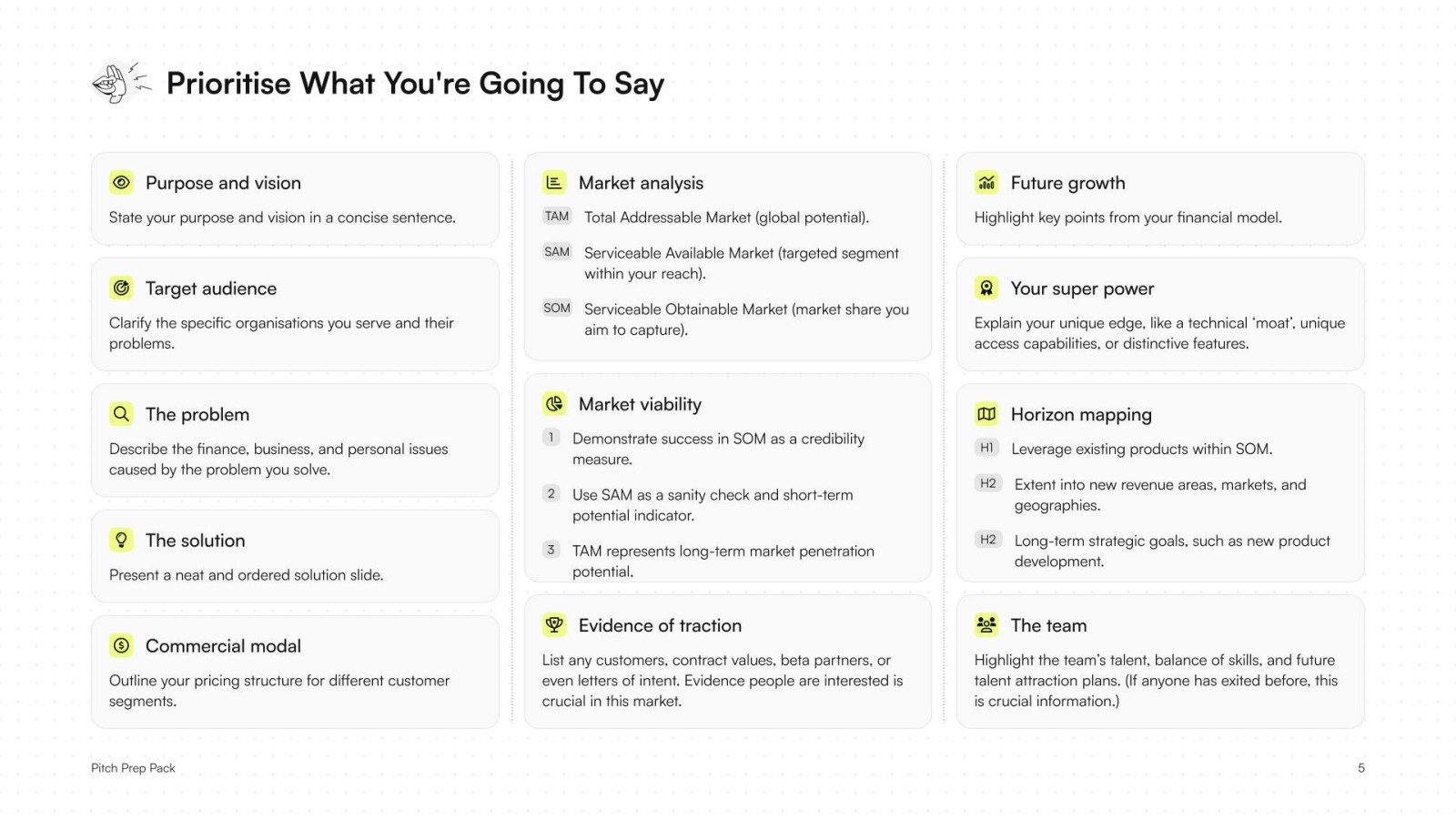
Then comes the market. How big is the problem? What's your TAM (total addressable market)? Can you capture enough of it to deliver a meaningful return? For tech businesses, investors are typically looking for 10–15x their initial capital over five years. Your market needs to be big enough to make that plausible.
What collateral do you need to pitch to investors?
This is where a lot of founders overthink it. Or underthink it. The essential documents, according to Neil, are:
- An investor deck (10–12 slides max. 40-page decks get binned)
- A financial model
- A one-page executive summary for initial approaches
- MEGA BONUS: an interactive prototype that brings your product to life
Business plans and information memoranda? Neil rarely sees them these days. The deck and model do the heavy lifting.
But within those documents, every word matters. The key sections to nail: your purpose, target audience, problem and solution, market analysis, evidence of traction, and your team.
And the thing that's become increasingly important in 2026? Traction. Proof of concept. Evidence that people actually want what you're building. Even if you're pre-revenue, you can demonstrate this through letters of intent, development partners, beta users, or pilot customers.
Investors are no longer willing to go on a wing and a prayer.
Free guide
Get the Pitch Prep Guide Pack
10 pages of practical frameworks to nail your investor pitch. Designed by a team that's helped 150+ startups raise millions.
Download for free
Do you need a prototype?
The short answer is an emphatic 'yes'. A protoype can change everything.
This is something we've seen at SmplCo SO many times. In the webinar, Michael quoted Chris Tottman, a well-known VC investor from Notion Capital:
"Investors are pattern-matching machines. We've seen thousands of pitch decks. When you put a working prototype in front of us, everything changes."
A simple, interactive, clickable prototype that you can demonstrate live elevates you above the crowd. It turns your pitch from "let me tell you about my idea" into "let me show you."
We create these, with Silicon Valley levels of UX and UI quality, in five days, and we've seen founders raise tens of thousands, even hundreds of thousands, off the back of them.
It's the old adage: 'show, don't tell'. Decks simply can't bring what's in your head to life the way a prototype will.
Drop us a line if you want us to explain further.
How should you approach investors?
Not with a blanket email blast. Please.
Neil outlined four channels, and each requires a different approach:
-
Warm introductions. The gold standard. A founder they've already backed, or an angel whose judgement they trust, passes your details along. You're not making the approach; someone credible is doing it for you. This is what Neil does for a living.
-
Back-channel networks. A co-investor forwards your deck to another investor. Again, the recommendation comes from inside the ecosystem.
-
Public presence. LinkedIn, events, content, social proof. The more visible you are before you approach, the more likely investors have already heard of you when your deck lands.
-
Cold outreach. Not inferior, just harder. It's a different skill. If you don't know any investors, you can still raise. It just takes more persistence and a sharper message.
Who are all these different investor types?
Quick primer for those who need it:
- Angels: High-net-worth individuals, sometimes investing alone, sometimes in syndicates to share risk
- Super angels / UHNW syndicates: Larger individual cheques, typically up to a couple of million across a syndicate
- VCs (venture capitalists): Raise funds from limited partners (LPs), often structured as EIS funds. If your business is EIS-eligible, you're more attractive to them
- Family offices: Start at around half a billion in total wealth. They invest their own money, move faster than VCs, are less risk-averse, and typically take a 20–25% stake
- PE houses: Later-stage, profitable businesses. Usually take a 60%+ controlling stake
The chronology matters: friends and family first, then angels, then Series A. Don't try to skip stages. If you haven't raised £500k, you're unlikely to raise £2.5m. You'll be too early-stage for the investors at that level.
How do you nail the pitch itself?
Mike's colleague Lasse (who sold his last company for $2.8 billion) always says: "You've got three minutes to make or break your pitch." Three minutes. If you don't capture attention at the start, you're done.
Neil's pitch essentials:
- Keep to time. Learn it by heart. No cue cards
- Lots of eye contact
- Tell a passionate, compelling story. You might be one of ten pitches that day
- Cover anticipated investor questions in the deck itself so they're not left wondering
- Don't be overconfident or defensive. If you've got this far, the investor is looking to invest. Go in with a positive attitude
- Know your numbers. They will spot anomalies. If growth looks too steep or there's an unexplained cost spike, have an explanation ready
The "Gina" technique: storytelling that sticks
This was one of my favourite moments from the webinar. Mike shared a brilliantly simple storytelling exercise from our Pitch Prep Guide that helps founders open their pitch in a way that actually makes investors sit up:
Create a character. Give them a name. Say, 'Gina'. Gina has a problem. Describe who she is and what she does, her day, her frustrations, and the pain she's dealing with. Now show what happens when Gina uses your solution. A, B, C and - boom! - Gina's day is transformed. She gets XYZ specific benefits and they matter to her for [the following reasons...]
It's simple. It's human. And it works because without Gina, you're just another faceless product. With Gina, you're telling a story investors can see, feel, and remember.
Our guide walks you through the whole exercise. Grab it free here.
What happens after they say "we're interested"?
The hard work doesn't stop. Neil walked through the post-pitch journey:
- Due diligence. They interrogate everything in your data room (i.e. a secure, centralised place where you've stored all your important, confidential documents). This process is getting deeper and more thorough every year.
- Term sheet. A negotiating document outlining how much they'll invest, at what valuation, and under what conditions.
- Pre-conditions. They might want you to hire a finance director, strengthen the management team, or hit certain milestones before the money flows.
- Contract and close. Negotiate the term sheet, sign the contract, receive the investment.
It's rarely linear. It takes patience, persistence, and a thick skin.
The bottom line
Fundraising in 2026 is harder in some ways. More due diligence, higher expectations around traction, deeper scrutiny of your numbers. But bigger cheques are being written for founders who get it right.
The formula hasn't changed: solve a real problem, prove people want it, tell a compelling story, know your numbers, and approach the right investors in the right way.
If you want to go deeper, watch the full webinar. And if you want hands-on help getting investor-ready, from prototypes to pitch decks to introductions, download our free Pitch Prep Guide or get in touch.
We're offering free half-hour investor-readiness consultations. Choose from:
- An Investor-Ready Audit with Neil and Michael - focus: your journey to landing investment; AND/OR
- An Investment Story Audit with Michael and Andreas (MD of SmplCo) - focus: how to best tell investors your story (including the specific collateral you will need to win them over)
No strings attached. Because the founders who prepare properly are the ones who raise successfully. And that's what we want to see.
A word on Barclays Eagle Labs
A massive thank you to the Barclays Eagle Labs team, and Lilly Chatwin in particular, for hosting this session. Eagle Labs is a genuinely brilliant resource for founders at any stage. They've got 42 locations across the UK, everything they offer is completely free, and you don't need to bank with Barclays to benefit.
If you're raising or thinking about raising, their Demo Directory is well worth a look. It's a great way to get your product in front of the right people. And their Female Founders Rise programme is doing important work to close the gender gap in funding. Check them out.
Watch the full webinar

About the author
Andreas Melvær
Managing Director & Co-founder, SmplCo
Andreas is the MD and co-founder of SmplCo. A product nerd at heart, he leads the company's 5-Day Prototype service and has helped 150+ startups and enterprises turn ideas into working digital products. He builds with AI, ships with speed, and occasionally wins marketing awards.
Keep reading

The 2 most important questions you can ask yourself before pitching to investors
What's the most common mistake founders make when they pitch? Putting features before benefits. Here's the simple two-question exercise that fixes it.
The most important UI trend? Trust.
AI makes it trivial to ship a working app. It also makes every app look the same, and users can feel it before they can explain it.
How to Make an MVP Go Viral: 3 Lessons from 10,000 Hits
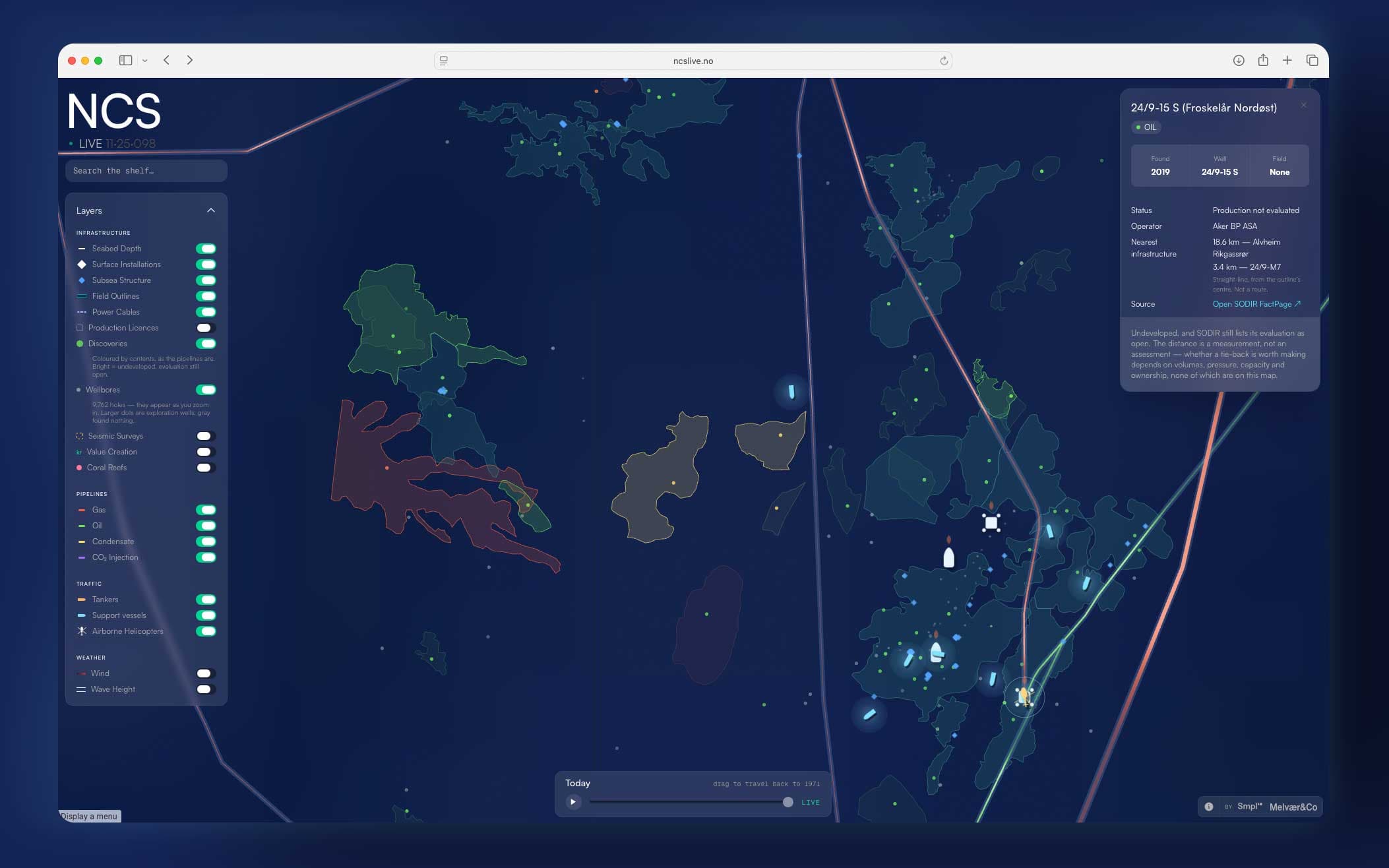
NCS Live drew 10,000 users in six hours. Three lessons on scope, immediate value, and letting the people who use your MVP shape what comes next.