How to Make an MVP Go Viral: 3 Lessons from 10,000 Hits
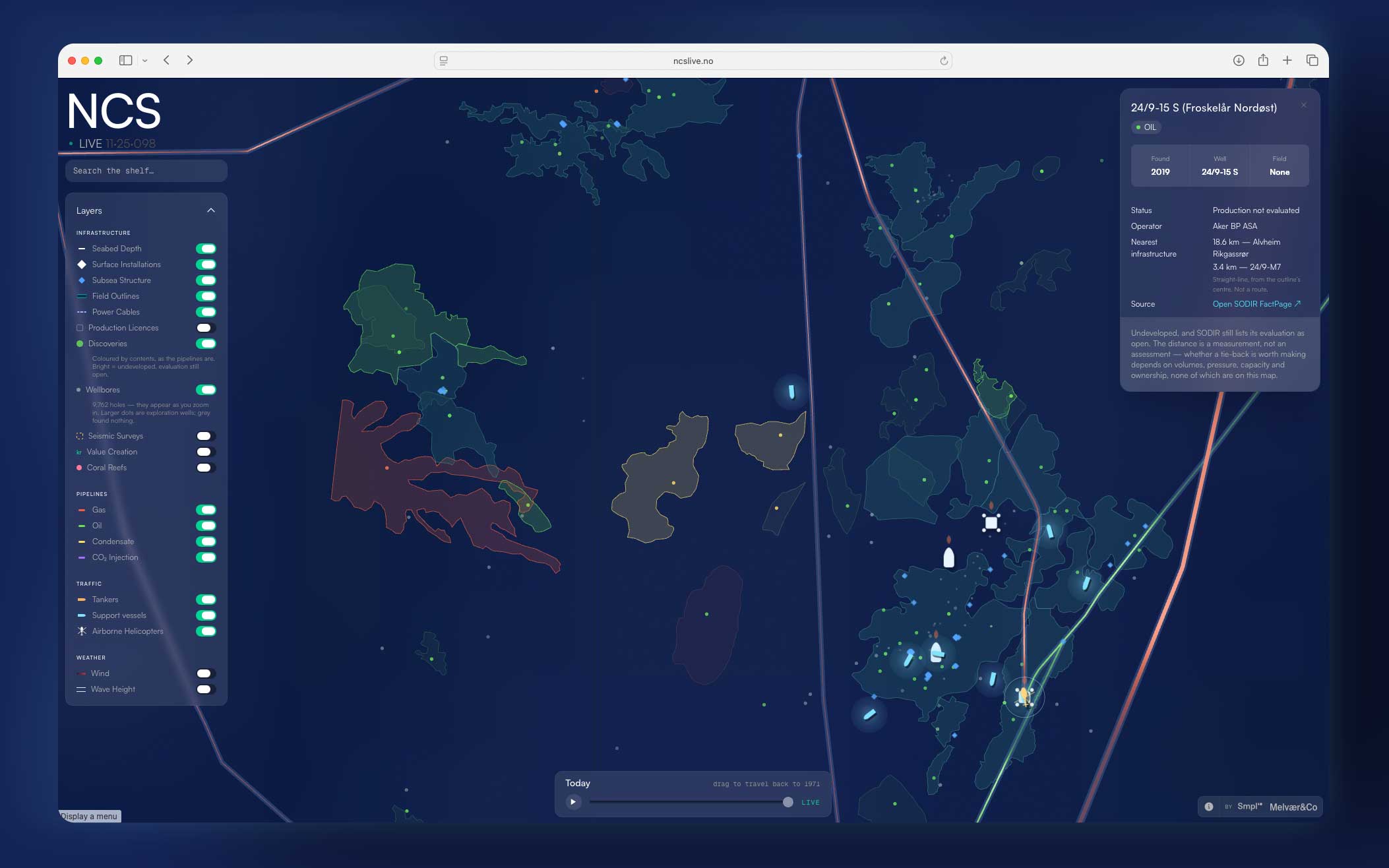
Ahead of energy mega conference, ONS, we launched NCS Live, a living, breathing map of the entire energy operation on the Norwegian Continental Shelf. Zero marketing spend and no launch event beyond a post of Linkedin.
Then things went a bit nuts.
10,000 hits in 6 hours and so much input from industry experts that we're now crowd-sourcing how we develop it.
And, while this makes us very excited, there are some BIG lessons for entrepreneurs and innovators everywhere about how to create a successful Minimum Viable Product (MVP).
And, being the nice folks we are, we'll share them now:
Lesson 1: How Do You Create Value Immediately?
Dependent on who you are and where you are, 'MVP' can have very different definitions.
As far as we're concerned, an MVP is the smallest version of your product that can create the most value in the shortest possible time. (This is exactly the thinking that gave birth to SmplCo and our, now famous, 5-Day Prototype process.)
Lots of people have started substituting MVP with MLP - 'Minimum Lovable Product' - which I think sums this idea up nicely. (FYI: this idea is not to be confused with, or connected to, the vibecoding phenomenon, Lovable.)
Particularly in early days, your users will absolutely not suffer anything that:
- isn't easy to get into. You MUST NOT neglect the onboarding process. We have team members that are specialists in onboarding. That's their thing. Because it's so crucial to engagement and retention.
- doesn't give users immediate value. Don't faff about. Don't try to impress them with bells and whistles. People don't have the time and the patience. The customer journey needs to take them the beating heart of your product - your raison d'etre - straightaway.
Of course, to get this right this, you've got to know your users really well.
We - and NCS Godfather Andreas Melvær in particular - have been working in and around the energy industry for some time, so we knew what problems were worth solving.
In the case of our MVP we focused on:
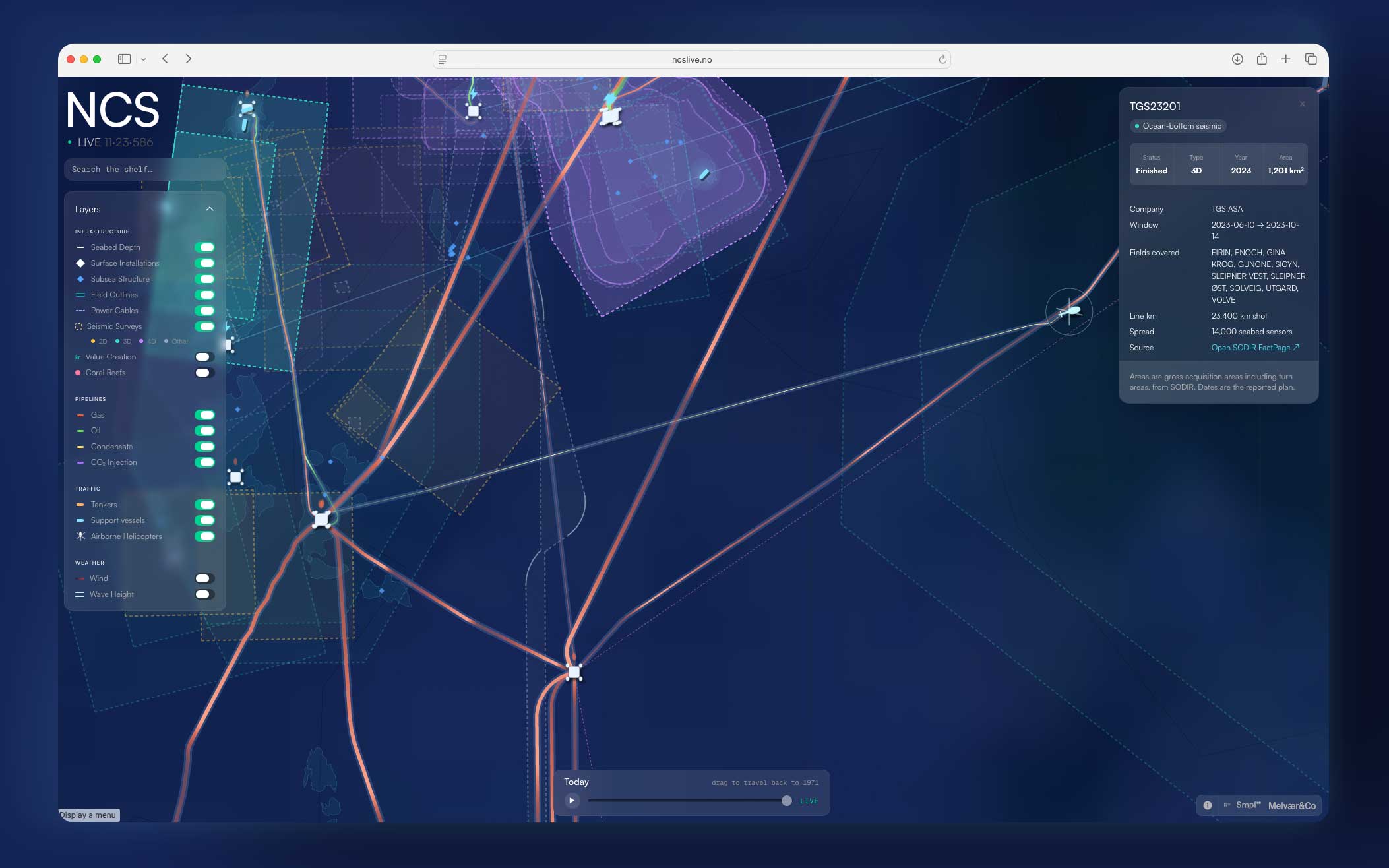
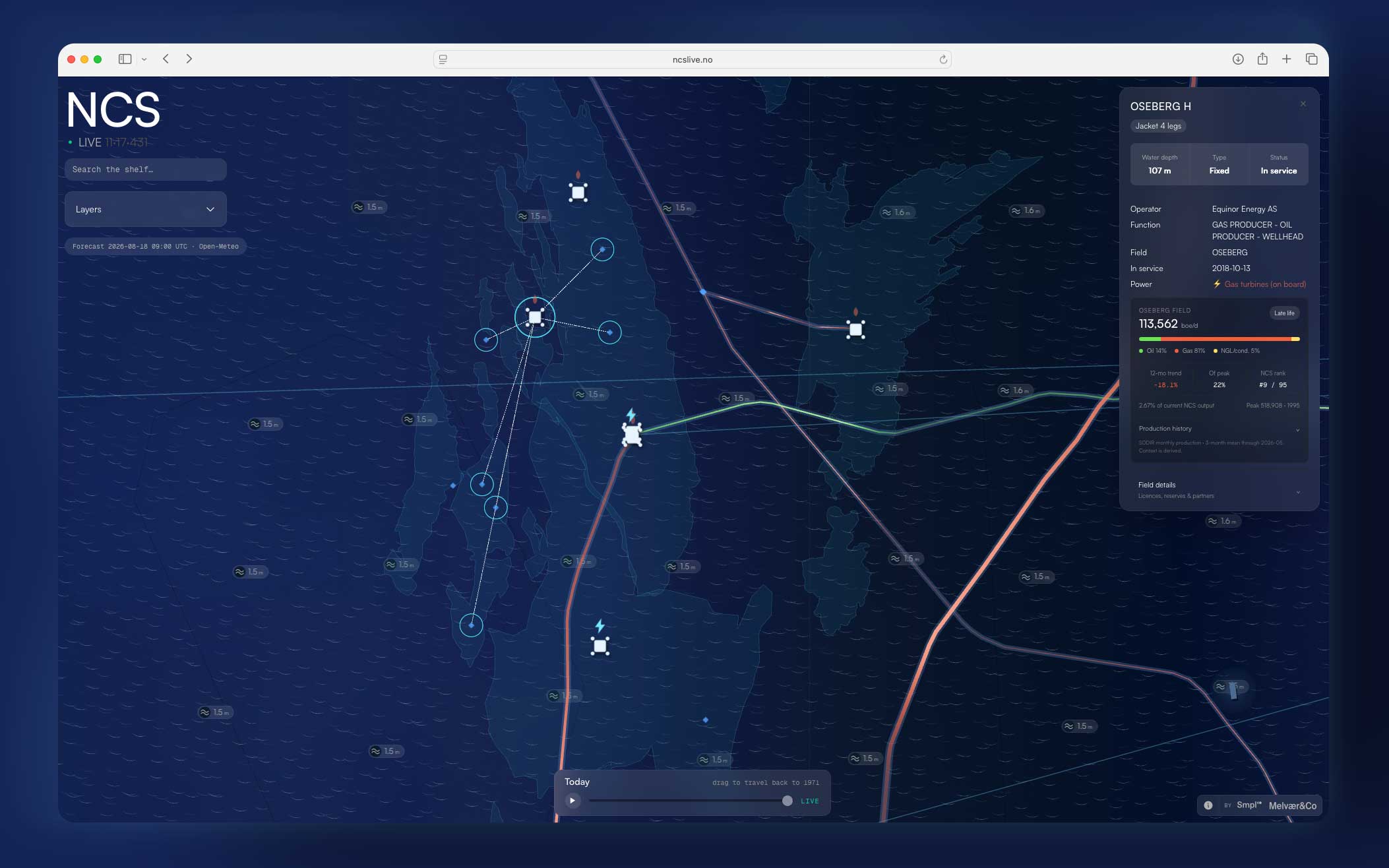
- Making the areas we focused on really comprehensive: our MVP shows every in-service installation and subsea structure (about 160 surface, 525 seabed), the full pipeline network, live vessel traffic from AIS, offshore helicopter movements, field partners and licence shares, production volumes, seismic survey activity, power-from-shore connections, and bathymetric seabed relief. It’s even got a year slider that replays the shelf building itself from 1971 to today (including showing the value that accrues).
- Helping users tell a story: several people at operators told us this is the clearest tool they have for onboarding new staff and for explaining the shelf to people outside the industry: politicians, journalists, graduates, the public. (The animated fifty-five-year build-out alone is rather better than any slide deck anyone has ever created!)
- Empowering research: using our tool domain experts can look into which surveys have been shot over this field, and when; what is tied back to that platform; who holds the licence and in what shares; which installations run on power from shore rather than gas turbines; what is producing right now, and what it is worth. And every number is labelled with where it came from and how derived figures were derived. This is INCREDIBLY hard to do normally.

Lesson 2: Don't build a monster
We started small with a minimum viable/lovable product - based on the lesson above - and grew it based on user need. We also used (documented, reliable) open-source data to drive rapid momentum at our end.
In short, we worked extremely hard to make the project simple for us to create and simple for users to adopt.
FAR too many entrepreneurs try to build too much, too early, and they drown in their own project.
If you work with SmplCo, we will spend a lot of time challenging you to stay focused. We’ve seen it SO many times: a client has a great idea, but new ideas come to them day and night and that great idea soon turns into a monster.
Projects like this are doomed.
A start-up recently came to us with an 'MVP' that would take months and months and months to build and cost well into six figures.
We're now talking to them about something a fraction of the size, cost, and time. And it will give them the momentum, investor interest, and customer engagement they need.
Small is beautiful.
If you have an idea that has 15 parts, we're going to get/force you to focus on the best three. The easiest way to do that is to go through them all and prioritise, leaving out the ones that aren’t new or innovative, or those that won’t influence how it sells in the market.
There’s a saying: ‘kill your darlings’. We won’t ask you to kill them, but we will ask you to put them aside for now if they’re not core to your idea.
Lesson 3: Don't be afraid to ask your audience for help
So many innovators worry about (or don't bother about) validating their idea with users.
Some think the idea will get stolen (it hardly ever does).
Others are so sure of their own genius they're certain of success without asking anyone if they need this. Others worry that people won't engage.
As our project shows, if you create something of value to users, they will engage and they will help you make it better.
In fact, we’ve had so much community engagement and advice on what to add that the evolution of NCS is basically being crowd-sourced. Check out some of the comments and advice we got when we posted this on LinkedIn:
One reader, a UK-based engineer, pointed out the map makes visible some of the chokepoints in Britain's energy import infrastructure. (That is a story in itself, and the map is a research tool for it.)
The point is, if you've followed the first two lessons above, lesson three should be the easiest of all.
You'll be fixing a problem you know needs fixing, you'll be doing it in a way that provides instant value, and you'll do it in a way that engages people and makes them want more.
And that, ladies and gentlemen, is what makes a great MVP and will help ensure you've got a viral hit on your hands.
If you're trying to figure out what your MVP should be you want a second pair of eyes, book a FREE MVP consultation with the team, or just get in touch for a chat. We're call happy to help you map it out, without the hype.

About the author
Michael Millar
Partner & Co-founder, SmplCo
Michael is a partner and co-founder of SmplCo. Before taking on go-to-market responsibilities for both SmplCo and our clients, he was a journalist (BBC, Reuters, Spectator), political lobbyist, and global comms leader.
LinkedIn →Frequently asked questions
- What is an MVP?
- An MVP, or Minimum Viable Product, is the smallest version of a product that can create the most value in the shortest possible time. It should not be confused with a stripped-down, half-broken prototype: whatever it does cover should work brilliantly.
- How do you make an MVP go viral?
- NCS Live hit 10,000 hits in six hours by doing three things well: giving users immediate value the moment they opened it, staying deliberately small and focused instead of trying to cover everything, and asking early users for feedback in public rather than guessing what they wanted. Virality followed usefulness, not a marketing push.
- Why do so many MVPs fail to gain traction?
- Most MVPs stall because founders try to build too much too early. A 'minimum' product with fifteen features and a six-figure budget stops being minimum, takes months longer to ship, and often runs out of money before real users ever see it. Prioritising ruthlessly and shipping a small, focused version first is what creates momentum.
- Should I ask users for feedback before adding more features to my MVP?
- Yes, and as early as possible. Founders often delay this because they worry the idea will get stolen (it rarely is) or that people will not engage (they will, if the product is genuinely useful). NCS Live's own roadmap is now being shaped by feedback from the industry experts who use it, gathered publicly rather than assumed.
Keep reading
The most important UI trend? Trust.
AI makes it trivial to ship a working app. It also makes every app look the same, and users can feel it before they can explain it.
AI and the Demise of Great UI
Everyone can 'design a product' with AI now. Our UI/UX Design Lead, Leonardo Hernandez, on why AI-led design still looks like AI-led design, and what actually earns a user's trust.